 My little but fruitful adventure with Homemade London has begun with a small note published in “The Evening Standard” (I would be more than happy to picture it here but I threw it away during one of my recent cleaning phases...) It said that Homemade London is a place in the heart of London to develop your craft skills and try workshops tailored for anyone and everyone. It has sparked the interest.
It took me awhile to make a step #2, literally. As I was planning to visit Homemade I broke my foot and had to postpone the trip. Once I finally got fixed I wrote an email to Nicola Barron, founder of the business, who invited me over to visit their main place at Seymour Place just behind Marble Arch or to pop in to their summer pop-up shop in Whiteley around Queensway. So I went.
At the Seymour Place I met Francesca who is Homemade manager. She studied wood design and came to Homemade via internship. “I came for a month and then Nicola asked me if I would like to stay for one more and another, and another, so I stayed for good. I enjoy being in such creative place even while doing some sort of office job. Homemade involves a lot of preparation but also meeting people, hearing their stories and enjoying the world of creativity ” – says Francesca.
 Seymour Place is mostly open in the evenings for the actual workshops. Homemade offer includes such craft workshops as perfume making, lingerie decorating, tote bag painting, drum-style lampshade making, jewellery making as well as mystery workshop which last an hour and visitors don’t know what they are going to create until they arrive at the place. Prices start from ₤10. “People come to us for different reasons. They want to do something creative, crafty and simply have fun. It amazes them that within an hour or one afternoon they can create something they wouldn’t do before” – says Francesca. Homemade also offers workshops for a special ocassion as birthdays, hen nights or corporate incentive parties. “People are looking for something original to celebrate special occasion. Also, many women don’t want to go for a typical hen party with dancing and stripteases – they prefer to come to us and do something creative. We take care of them during this important time and it’s also our customer service which attracts them to the place” – Francesca explains.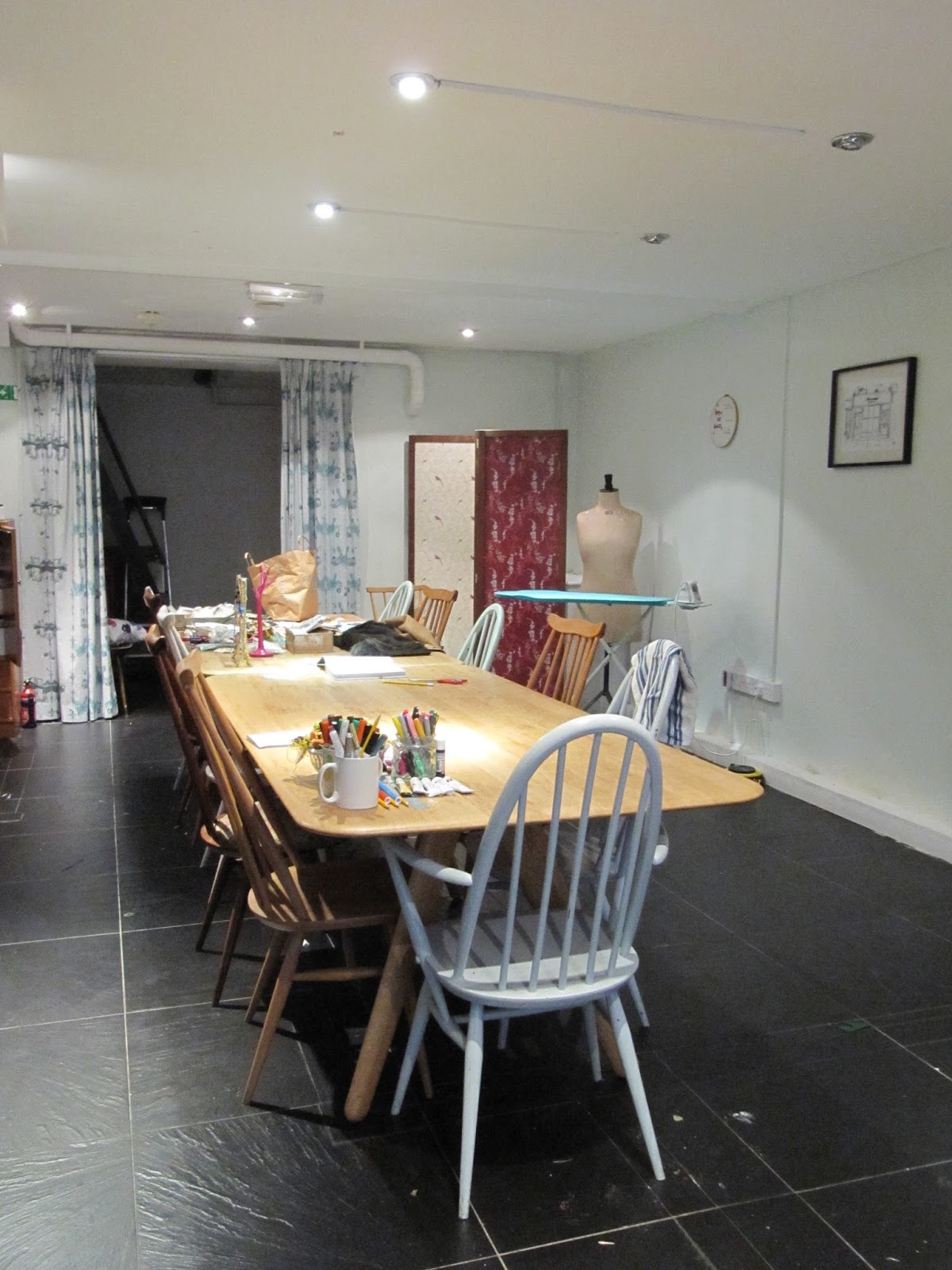
Homemade shop window is decorated with white and blue what reminds me of an old pantry where you would store jams and other preserves, homemade of course. It creates the atmosphere of good old times when women would gather together to do some house works and catch up on gossips a bit. It gives a sense of creating something together and bringing the atmosphere of joy and passion among people.
Right after visiting “the headquarters” I walked to the pop-up shop in the Whiteley. I arrived there only few minutes before closing, so didn’t have too much time to talk and create but enough to get the idea about the business created by Nicola Barron.
When I came in to the glassed unit I saw two women making fabric necklaces and children painting on the other side of the table. Nicola was bustling among them giving instructions how to finish, put laces together etc. She welcomed me with smile and was happy to talk about this summer project as well as the main business.
Pop up shop in Whiteley is there only two days a week for the summer, so you have not much time left to visit. It’s open for all shoppers on Wednesday and Thursday until 5pm. Visitors vary, from individuals who spot the place while shopping to mums and nannies with children who come here to fill in the day. Nicola shows me little masterpieces made within couple of weeks – cotton Oyster card holders, little paintings and others. People come and within short time can create something artistic which they can take home.
It’s encouraging not only in artistic dimension but also as a business. Nicola before opening Homemade was TV producer, so this idea was something new to her but she shares her experience of a start-up on the pages of magazine “Elite Business”.
What is the secret of Homemade? “We don’t plan too much in advance but we’re trying to adjust to weather and people needs. I think this place is popular, because people see they can do something different, create something within short time and socialise in a different way than usual. Apart from that, everything is very simple, so anyone can come – person who has some previous craft experience will do something more complicated but person with no experience will create something simple and not feel intimidated at the same time.”
The last but not the least step was to take part in actual workshops. As a beginner and a fan of unknown I choose the mysterious one. I arrived to the place slightly late, so when I came in Nicola had been already explaining what was going to be the theme. As she was holding a coat hanger in her hands she had all of the ladies starring at her and soaking in her every word. They all came curious, wanting to try something new or encouraged by previous workshop they attended and ready to practice their skills. Task for that day – I heard – was to decorate a coat hanger with cloths. Nicola presented us a ready one with a cute bow – as for me unattainable ideal. As soon as we got the instructions we moved to chest with pieces of garments where everyone could let their imagination and fashion skills unfurl. Some participants, like me, would pick up everything what they thought could be useful and later do the selection, while others once they saw one piece, they immediately knew what they wanted to match it with. Some already had an idea before coming to the chest!
When I came in to the glassed unit I saw two women making fabric necklaces and children painting on the other side of the table. Nicola was bustling among them giving instructions how to finish, put laces together etc. She welcomed me with smile and was happy to talk about this summer project as well as the main business.
Pop up shop in Whiteley is there only two days a week for the summer, so you have not much time left to visit. It’s open for all shoppers on Wednesday and Thursday until 5pm. Visitors vary, from individuals who spot the place while shopping to mums and nannies with children who come here to fill in the day. Nicola shows me little masterpieces made within couple of weeks – cotton Oyster card holders, little paintings and others. People come and within short time can create something artistic which they can take home.
It’s encouraging not only in artistic dimension but also as a business. Nicola before opening Homemade was TV producer, so this idea was something new to her but she shares her experience of a start-up on the pages of magazine “Elite Business”.
What is the secret of Homemade? “We don’t plan too much in advance but we’re trying to adjust to weather and people needs. I think this place is popular, because people see they can do something different, create something within short time and socialise in a different way than usual. Apart from that, everything is very simple, so anyone can come – person who has some previous craft experience will do something more complicated but person with no experience will create something simple and not feel intimidated at the same time.”
The last but not the least step was to take part in actual workshops. As a beginner and a fan of unknown I choose the mysterious one. I arrived to the place slightly late, so when I came in Nicola had been already explaining what was going to be the theme. As she was holding a coat hanger in her hands she had all of the ladies starring at her and soaking in her every word. They all came curious, wanting to try something new or encouraged by previous workshop they attended and ready to practice their skills. Task for that day – I heard – was to decorate a coat hanger with cloths. Nicola presented us a ready one with a cute bow – as for me unattainable ideal. As soon as we got the instructions we moved to chest with pieces of garments where everyone could let their imagination and fashion skills unfurl. Some participants, like me, would pick up everything what they thought could be useful and later do the selection, while others once they saw one piece, they immediately knew what they wanted to match it with. Some already had an idea before coming to the chest!

We all spent next hour in the world of a coat hanger... and a bit of chat, of course. My mind concentrated on sticking the cloth correctly to the hanger with a help of a lampshade tape. Making it not too thick. Making sure the colours match. Finishing a part of material in a right place. Finishing it nicely.
At the same time I was talking to Larissa, a finance person doing financial translation at the moment and also teaching bollywood dancing (while not being pregnant). A truly wonderful person to chat over a hanger. (Larissa I wanted to take your phone number but finally lost you somewhere, so if you come to the blog and would like to chat some more, you can email me).
It was an hour somewhere far away from the normal life of London. An hour of being creative. An hour of being concentrated. An hour of thinking which colours match the best on a coat hanger. I don’t think about such things every day, trust me. That time I realised how wonderful is to get back to such things. Concentrate. Fly away. Open to people. Laugh and do something with your hands and realize that they are not all fingers & thumbs. And I went home happy, holding my trophy in hands and presenting it proudly to my husband. More coat hangers are already in line for a makeover. And now, I am off to Whitley pop-up shop to use my last summer chance to be creative! -JS-F


